# Who is Michael Burry? The Big Short investor bet against Nvidia while our best graded accounts stayed nearly 6-to-1 bullish
> Michael Burry is the Big Short investor who now writes the Cassandra Unchained Substack. His Nvidia puts, Scion's 13F filings, why no net worth figure holds up, and what the accounts we track said about Nvidia during his short.
By Maya Koeva · 2026-10-26
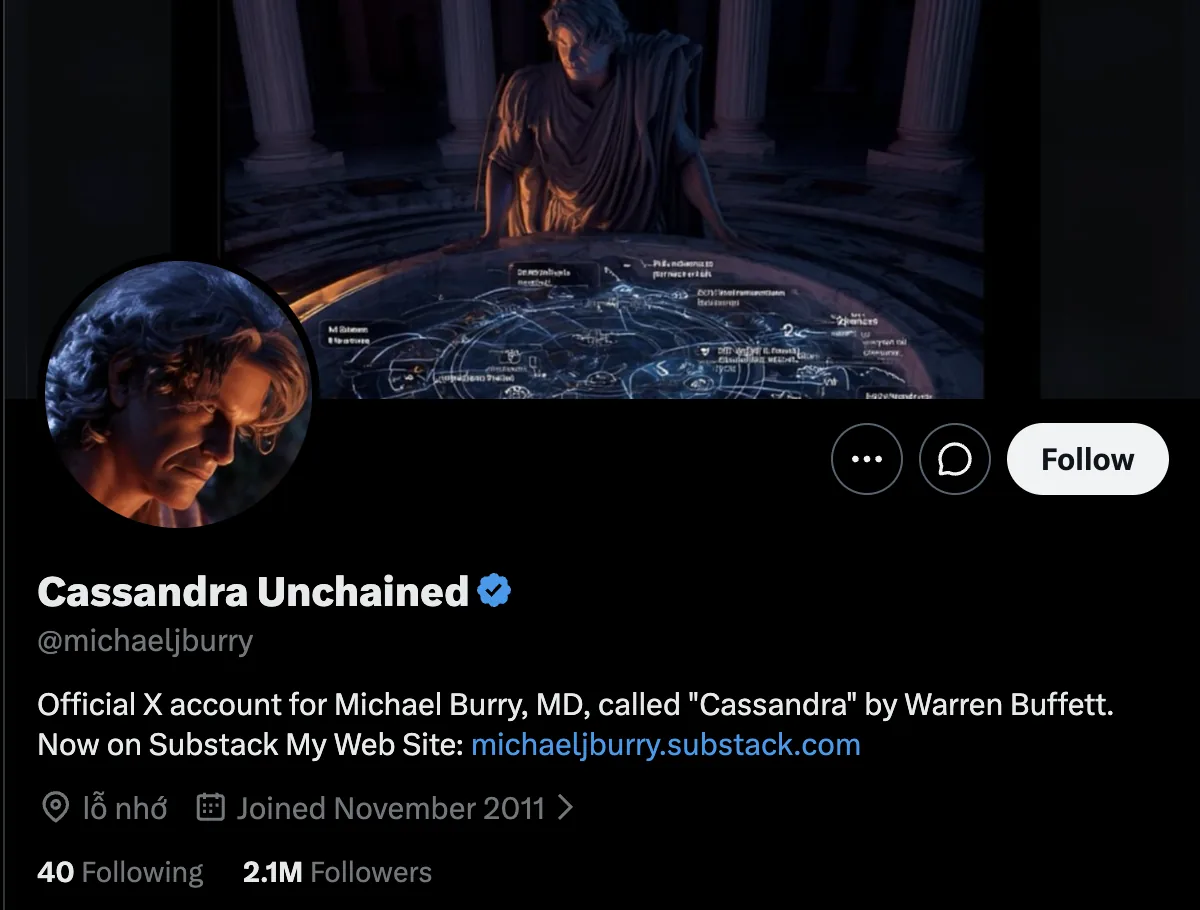
Michael Burry is the physician turned fund manager who bet against the US housing market before
2008 and became the hero of *The Big Short*. Since November 2025 he has closed his firm to the SEC,
moved his market calls to a paid Substack called Cassandra Unchained, and spent most of the
past year betting against Nvidia. This page is his public record: the 2008 trade, Scion's
filings, the Nvidia bet, the Substack, his X account, and why no net worth figure for him holds
up.
Quantral does not track or grade Burry. We do track Nvidia. From November 3, 2025, the day
Scion's filing showed its Nvidia puts, to October 23, 2026, the accounts with graded track
records on Quantral ran 728 bullish to 128 bearish on Nvidia, close to 6 to 1. Everyone else
ran 2.5 to 1. Of the bearish Nvidia calls in that window old enough to have a 90-day result,
47 of 411 were right.
## Who is Michael Burry?
Michael Burry is an American investor and physician, best known for his bet against subprime
mortgages before the 2008 crash. The facts on public record:
- **Background:** born June 19, 1971, in San Jose, California. He studied economics at UCLA,
earned his MD at Vanderbilt in 1997, and left his Stanford residency training unfinished.
- **Before the fund:** from 1996 he posted value-investing write-ups on the Silicon Investor
message boards while still in medical training.
- **Scion Capital:** the hedge fund he started in late 2000 and closed in 2008, after the
housing short paid.
- **Scion Asset Management:** the firm he reopened in 2013. Its SEC registration was terminated
on November 10, 2025.
- **Writing now:** the Cassandra Unchained newsletter on Substack since November 2025, and
[@michaeljburry](https://x.com/michaeljburry) on X.
- **On screen:** Christian Bale played him in the 2015 film of *The Big Short*.
## Michael Burry and The Big Short
Burry's fame rests on one trade. After studying mortgage lending in 2003 and 2004, he turned to
the subprime market in 2005 and used credit default swaps, a kind of insurance contract, to bet
that pools of subprime home loans would default. He paid premiums on that bet for about two
years while the housing market kept rising, and some of his own investors pushed to pull their
money.
When the loans went bad in 2007 and 2008, the swaps paid. His Wikipedia entry, citing the
reporting at the time, puts his personal profit at about $100 million and the profit for the
investors who stayed at more than $700 million. He shut Scion Capital in 2008.
Michael Lewis told the story in *The Big Short* (2010), and the 2015 film made Burry the
best-known short seller of his generation. Twenty years on, a one-line post from him still makes
headlines, and his name trends each time a new short of his comes out.
## Scion Asset Management and its 13F filings
Burry reopened in 2013 as Scion Asset Management. It reported about $155 million in assets in
March 2025, per Reuters, and filed a quarterly 13F with the SEC, the form that lists a fund's US
stock and option positions at the end of each quarter. Those filings are where most of his
famous calls became public, because he rarely explained them at the time.
| Quarter end | Filed | What the 13F showed |
|---|---|---|
| | Aug 14, 2023 | Puts on the S&P 500 and Nasdaq-100 ETFs worth about $886 million and $739 million on paper |
| | May 15, 2025 | Puts on 900,000 Nvidia shares ($97.5 million on paper), puts on Alibaba, Baidu, JD.com, PDD and Trip.com, and Estée Lauder as the only stock left |
| | Aug 14, 2025 | Every put gone. Calls on UnitedHealth, Regeneron, Lululemon, Meta, Estée Lauder, ASML, JD.com, Alibaba and VF instead |
| | Nov 3, 2025 | Puts on 5 million Palantir shares ($912.1 million on paper) and 1 million Nvidia shares ($186.6 million), plus calls on Pfizer and Halliburton |
The dollar figures in a 13F are notional: the number of shares the options cover times the
quarter-end price. The Nvidia line in the last filing is 1 million shares at Nvidia's
September 30, 2025 close of $186.58. It says nothing about what the puts cost, their strike or
their expiry. Burry made the point himself on X after the November filing: he said the Palantir
puts behind the $912 million headline had cost about $9.2 million.
The November 3, 2025 filing was the last one. A week later the SEC listed Scion's registration
as terminated, effective November 10. Burry posted a screenshot of the status on X with a
teaser that he was "on to much better things" on November 25. A fund that is not registered
does not have to file 13Fs, so his positions since then are known only from what he writes.
Scion was also an early GameStop holder. In an August 2019 letter to the board it disclosed about
3% of the company and urged a buyback, well before the 2021 squeeze that made
[Roaring Kitty](/blog/who-is-roaring-kitty) famous.
## Did Michael Burry short Nvidia?
Yes, more than once. Scion's filings show puts on Nvidia at the end of March 2025 and again at the
end of September 2025, and in 2026 he described a short stock position and puts in his
newsletter. What he disclosed, and when:
| When | What he disclosed | NVDA close |
|---|---|---:|
| | 13F: puts on 900,000 shares | $108.38 |
| | 13F: the Nvidia puts are gone | $157.99 |
| | 13F: puts on 1 million shares | $186.58 |
| | That 13F is filed and the puts become public | $206.88 |
| | Launches his Substack with a post arguing AI is a supply-glut bubble; Nvidia answers in a memo to analysts | $182.55 (Nov 24) |
| | Substack: added to his Nvidia short at $210.28, still holds puts | $206.84 |
| | Substack, hours before Nvidia's earnings: buys December calls as a hedge and adds to the short | $209.66 |
| | Substack: sells all his December 2026 Nvidia puts as he cuts risk; Nvidia is his fourth-largest short | $223.67 |
| | Substack: covers the Nvidia short stock, keeping the bet through puts | $228.86 |
| | Substack: a new post on GPU depreciation and Nvidia | $230.86 |
The 2026 rows come from his paid posts as reported by Stocktwits, Yahoo Finance and other
outlets. The reports we found give no full set of strikes, sizes or profit and loss for the
Nvidia trade, so how it has done is not public.
The case he makes is about accounting more than chips. In his first Substack posts and the ones
that followed, he argued that Nvidia's stock-based pay dilutes shareholders more than its
buybacks offset, and that the big cloud companies depreciate their GPUs over more years than the
chips stay useful, which flatters their earnings and the demand behind Nvidia's sales. Nvidia
disputed both points in a memo to sell-side analysts the weekend of November 22, 2025. Burry
replied that his comparison was Cisco in 2000: a real business at a bubble price.
Over the same stretch, Nvidia closed at $206.88 on November 3, 2025, the day the puts became
public. It fell to $165.17 on March 30, 2026, down 20%, climbed to $239.24 on October 6, and
closed at $210.96 on October 23, 2% above where it started.
## Michael Burry's Substack: Cassandra Unchained
Burry's Substack is
[Cassandra Unchained](https://michaeljburry.substack.com), and since he closed Scion to the SEC
it is where he discloses his trades. What is public about it:
- **Launch:** November 23, 2025, two days before the date he had teased on X. His first two
posts covered his memories of the 1999 bubble and his case that AI is a supply-side bubble,
with Nvidia at the center.
- **Price:** it launched at $39 a month or $379 a year. A pricing post in late October 2026 said
the rate stays at $49 a month or $479 a year. Some posts and notes are free; the trade updates
are for paid subscribers.
- **Readers:** Burry said in July 2026 that it had passed 300,000 subscribers, a count that
includes free readers. He has not said how many pay.
- **What it covers:** a regular "Trading Post" with his buys, sells and shorts, longer research
series on AI spending and GPU depreciation, and a monthly charity pick.
Because the trade updates sit behind the paywall, almost every headline about a Burry position
in 2026 is a reporter or a reader summarizing a paid post. Treat secondhand position details the
way you would a screenshot: as a claim until the source confirms it.
## Michael Burry on Twitter (X)
Burry's X handle is [@michaeljburry](https://x.com/michaeljburry), with more than a million
followers. He has a long habit of posts that appear and vanish:
- **2021 to 2023:** he deleted and reactivated the account several times, including in November
2021 after a spat with Elon Musk. In December 2022 it briefly disappeared again; on his return
he said he would stop deleting.
- **2023:** a one-word "Sell" post in early 2023 was followed on March 30 by "I was wrong to say
sell." He then went quiet on X for about two and a half years.
- **October 31, 2025:** he came back with a post about bubbles, telling followers that sometimes
the only winning move is not to play, and renamed the profile Cassandra Unchained.
The Cassandra name is the Greek prophet whose warnings nobody believed, and he used it as a
nickname on X long before the newsletter. He still posts on X, on housing, Fannie Mae and
Freddie Mac and the AI trade, but his trade details are on Substack.
## Michael Burry net worth: what's documented
There is no verified Michael Burry net worth. We found no estimate from Forbes or Bloomberg, and
the figures on net worth sites cite no source. The documented numbers are these:
| What | Figure | Source |
|---|---:|---|
| Personal profit on the 2008 housing short | about $100 million | Wikipedia, citing reporting at the time |
| Scion Asset Management's assets, March 2025 | about $155 million | Reuters, from its SEC filing |
| Substack subscribers, July 2026 | over 300,000, free readers included | Burry |
| Substack price | $379 a year at launch, $479 a year now | Cassandra Unchained |
None of these is a net worth. The fund's assets included outside investors' money, the 2008
profit is almost two decades old, and the Substack's revenue depends on a paid subscriber count
he has not disclosed. Multiplying 300,000 readers by the annual price gives a ceiling, not his
income.
## What the accounts we track said about Nvidia
Since November 2025 the accounts we track have named Burry in more than 360 posts, most often
next to Nebius, Nvidia, Micron, Lululemon and Palantir. Below is what the accounts with records
did with Nvidia while he was short it.
From November 3, 2025 to October 23, 2026, Nvidia drew 4,609 mentions across the accounts we
track: 2,905 bullish and 1,001 bearish. The graded accounts, the ones with more than 10 resolved
calls and more right than wrong, were on the bull side quarter after quarter:
| Period | Graded accounts, bull to bear | Everyone else, bull to bear | NVDA over the period |
|---|---|---|---:|
| Nov 3 to Dec 31, 2025 | 39 to 14 | 44 to 10 | -9.9% |
| Jan to Mar 2026 | 102 to 19 | 107 to 21 | -6.5% |
| Apr to Jun 2026 | 203 to 41 | 530 to 281 | +14.7% |
| Jul to Sep 2026 | 310 to 43 | 1,121 to 435 | +14.1% |
| Oct 1 to 23, 2026 | 74 to 11 | 375 to 126 | -7.6% |
Price changes are close to close: from the November 3 close for the first row, and from the
last close before the period for the others, to the last close in it.
Both groups leaned bullish through the winter, when Nvidia fell. The gap opened in the spring. From April to June, when Nvidia climbed 15% for the quarter, the rest of the room ran
under 2 to 1 and the graded accounts held about 5 to 1. They stayed above 7 to 1 from July to
September, when the stock rose another 14% and reached the August 26 earnings print that
**[our pre-earnings read](/blog/nvidia-earnings-sentiment)** covered.
*[Chart: Nvidia daily closes from November 3, 2025, the day Scion's 13F showed its Nvidia puts, to October 23, 2026. The low was $165.17 on March 30; the close on October 23 was $210.96.]*
The bear side did not pay inside 90 days. Of the bearish Nvidia calls in the window that have
reached their 90-day mark, 47 of 411 were right, against 673 of 1,082 bullish ones. That grades
the calls the accounts we track made, not Burry's trade, which runs on longer-dated puts whose
full terms are not public.
The five accounts that posted about Nvidia most in the window:
| Account | Nvidia mentions | Bull | Bear | Track record |
|---|---:|---:|---:|---|
| @TheValueist | 262 | 215 | 24 | Top 10 |
| @pequityresearch | 219 | 162 | 22 | Bottom third |
| @Mr_Derivatives | 110 | 66 | 24 | Bottom fifth |
| @SemiAnalysis_ | 101 | 65 | 23 | Lower half |
| @Funmentalist | 78 | 64 | 8 | Bottom third |
The loudest of them, with a top-10 record, ran about 9 to 1 bullish. Mr_Derivatives and
SemiAnalysis_, both in the lower half of our ranking, ran under 3 to 1, the most bearish lean in
the group.
The accounts with records that wrote about Burry himself took on his numbers:
| Account | When | What they posted |
|---|---|---|
| @jmartinprin | | Put the day's Nvidia drop down to Treasury Secretary Bessent's comments on Blackwell chips for China, not to a short he called small and more than a month old |
| @ParadisLabs | | Said Nebius and CoreWeave earnings undercut the GPU-depreciation case, citing a CoreWeave contract for 2020-era A100 chips that runs into 2029 |
| @CKCapitalxx | | Credited his 2008 call, then laid out why Nebius's quarter, with revenue up 454%, did not fit his short |
| @aleabitoreddit | | Pointed to Oracle re-selling renewing GPU capacity at a 20% premium, most of it on gear four or more years old, as a point for Nvidia |
[ParadisLabs](/voices/paradislabs), [CKCapitalxx](/voices/ckcapitalxx) and
[aleabitoreddit](/voices/aleabitoreddit) rank in our top 20 by track record, and jmartinprin in
our top quarter. Each argued from a filing or an earnings call, which is the kind of evidence
you can check before you take a side.
## Check the filing before the headline
Lewis's reporting laid out Burry's 2008 trade in full, which is why it still holds up as the
best-known short of the century. His 2025 Nvidia puts reached the news through a 13F that lists
notional value instead of cost, and his 2026 trades reach most readers as summaries of
paywalled posts. Before you act on a famous short, check what he disclosed, when, and at what
size.
Across the accounts we track, his name on the bear side drew hundreds of posts, and the graded
accounts answered with earnings calls and filings while staying on Nvidia's bull side.
**[How to verify a track record](/learn/how-to-verify-a-track-record)** walks through checking
any voice, and **[Inverse Cramer](/blog/inverse-cramer)** runs the same test on the most famous
stock picker on TV. In the Quantral app, every Nvidia call from the accounts we track is graded
as it resolves, so you can see whose read has held up before the next filing lands.
## Michael Burry FAQ
### Who is Michael Burry?
Michael Burry is an American investor and physician who founded Scion Capital in 2000 and made
his name betting against subprime mortgages before the 2008 crash, the trade told in *The Big
Short*. He later ran Scion Asset Management, deregistered it with the SEC in November 2025, and
now writes the Cassandra Unchained newsletter on Substack.
### What is Michael Burry's net worth?
There is no verified figure. The documented numbers are his reported personal profit of about
$100 million on the 2008 housing short, Scion Asset Management's roughly $155 million in assets
in March 2025, which included outside money, and a Substack he says passed 300,000 subscribers,
free readers included. None of those is a net worth.
### Is Michael Burry still short Nvidia?
As of his late-September 2026 posts, as reported, yes, through put options. On September 28 he
said he had covered his short stock positions, Nvidia included, and replaced them with puts,
after selling his December 2026 Nvidia puts earlier that month. The reports give no strikes,
size or profit and loss for the remaining position.
### How big was Michael Burry's Nvidia short?
Scion's last 13F showed puts on 1 million Nvidia shares, worth $186.6 million on paper at the
September 30, 2025 close. That is notional value, not money at risk; the filing does not show
what the puts cost. His 2026 Nvidia positions were never filed, and the reports of his
newsletter give no dollar size for them.
### What is Michael Burry's Substack?
Cassandra Unchained, at michaeljburry.substack.com. He launched it on November 23, 2025, at $39 a
month or $379 a year; it now costs $49 a month or $479 a year. It carries his trade updates and
research on AI spending, GPU depreciation and value stocks, with the trade updates for paid
subscribers.
### What is Michael Burry's Twitter (X) handle?
@michaeljburry. He renamed the profile Cassandra Unchained in October 2025. He has deleted posts and the whole
account several times since 2021, and returned on October 31, 2025 after about two and a half
years of near silence.
### What is Scion Asset Management?
Burry's investment firm, reopened in 2013 after he closed Scion Capital in 2008. It filed
quarterly 13F reports with the SEC until its registration was terminated on November 10, 2025.
Its last 13F, filed November 3, 2025, showed puts on Palantir and Nvidia.
### Does Quantral track Michael Burry?
No. He posts his trades behind a paywall and Scion no longer files 13Fs, so there is no
public, timestamped call we can grade. We track the stocks he talks about, Nvidia included, and
grade the accounts that call them.
---
*Michael Burry and Scion Asset Management are not accounts Quantral tracks or grades. Scion's
positions come from its SEC 13F filings; his 2026 positions come from news reports of his
paid Substack posts and have not been verified against any filing. Nvidia prices are daily
closes. Mentions, quoted posts and rankings come from the accounts Quantral tracks, as of
October 26, 2026, with mention days in New York time. Quantral surfaces signals and context
from public sources to support your own research. Nothing here is financial advice or a
recommendation to buy, sell, or follow anyone. Past performance is not indicative of future
results.*