Inverse Cramer: the meme, the inverse Cramer ETF, and Jim Cramer's graded record
By Maya Koeva · October 22, 2026 · 10 min read
Inverse Cramer is the idea that you can make money by doing the opposite of what Jim Cramer tells you to buy or sell. On Quantral we graded 103 of his stock calls made between August 11 and October 12, 2026, and 30 of them were right.
That sounds like a case for inverting him, until you see the market he made them in. Across the stocks we track, the median stock fell in 86% of the week-long windows after his calls and in every month-long one, so a bullish call lost whoever made it. Two months like that cannot tell you whether betting against him pays.
Who Jim Cramer is
Jim Cramer hosts Mad Money on CNBC, weeknights at 6 p.m. ET, and co-anchors the 9 a.m. hour of Squawk on the Street (CNBC). Mad Money first aired in 2005, and since July 2022 it has been broadcast from the floor of the New York Stock Exchange (CNBC).
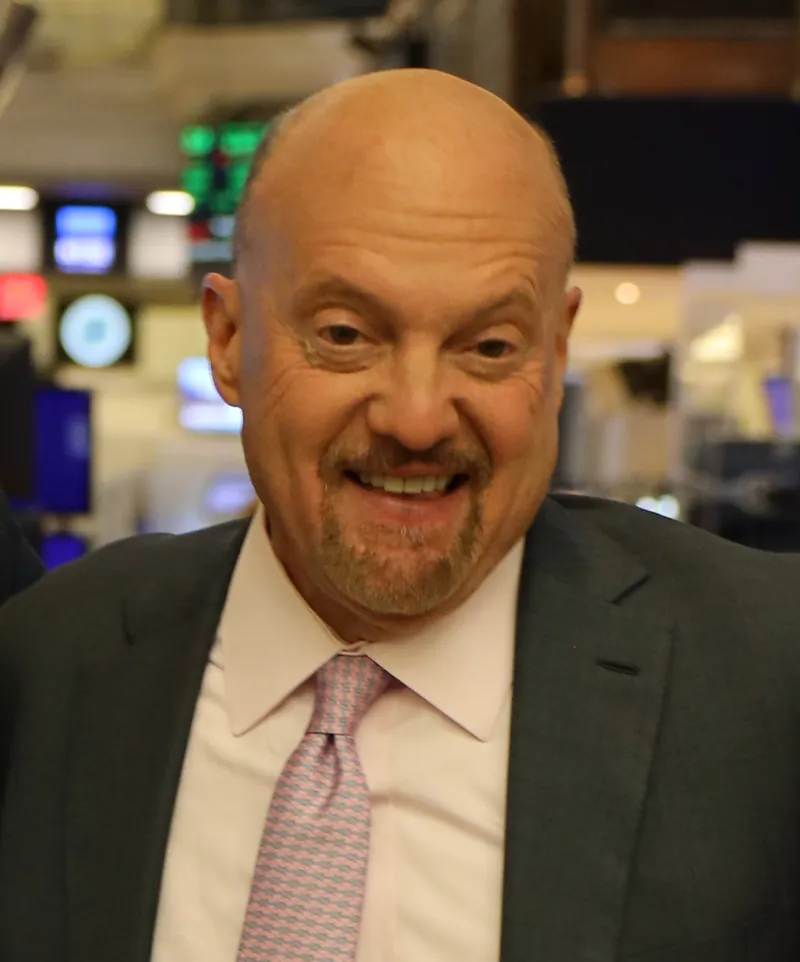
Jim Cramer on the floor of the New York Stock Exchange, November 2021. Photo: Bear Bull Traders, cropped, CC BY 2.0.
He came to television from money management. After Harvard College, where he ran The Harvard Crimson, and Harvard Law School, he joined Goldman Sachs in sales and trading. In 1987 he left to start his own hedge fund, later named Cramer Berkowitz, and retired from it in 2001 (Wikipedia). His CNBC biography puts his compounded return there at 24% a year after fees over 14 years. In 1996 he co-founded the financial news site TheStreet with Martin Peretz. Today he also runs the CNBC Investing Club, a paid service built around his charitable trust's portfolio.
Cramer covers a lot of stocks. In the Lightning Round, callers name one and he gives a verdict in a few seconds. Add the morning show and his posts on X, and he goes on the record about a long list of names every week, which makes him easy to keep score on.
Why "inverse Cramer" exists
The joke has a founding clip. On March 11, 2008, a Mad Money viewer asked whether to pull money out of Bear Stearns. "Bear Stearns is fine," Cramer told him (Columbia Journalism Review). Within a week, JPMorgan Chase agreed to buy the bank for $2 a share. Cramer has said he meant that the customer's money in a Bear Stearns account was safe, not that the stock was a buy (Wikipedia). Viewers remembered the clip, not the defense. A year later Jon Stewart played it on The Daily Show, and on March 12, 2009 Cramer sat for an interview there that drew one of the show's biggest audiences of the year.
The second clip came from the 2022 bear market. In June 2022 Cramer said Meta shares had nowhere to go but up. On October 27, after Meta fell 25% in a day on its earnings, he apologized on air: "I made a mistake here. I was wrong" (Fortune).
The timing made both halves easy to mock. The June call was early, and the apology came a week before the bottom: Meta closed at $97.94 that day and at its low of $88.91 on November 3. By the last trading day of 2023 it closed at $353.96.
By then, betting against Cramer was a long-running finance joke, and "inverse Jim Cramer" had become shorthand for it: if he likes a stock, sell it. In 2022 a fund manager decided to test the joke with real money.
The inverse Cramer ETF: what happened to SJIM
Tuttle Capital Management filed for two funds in October 2022, and both began trading on Cboe in early March 2023 (InvestmentNews):
- SJIM, the Inverse Cramer Tracker ETF, shorted the stocks Cramer recommended and bought the ones he told viewers to avoid.
- LJIM, the Long Cramer Tracker ETF, did the reverse and held his picks.
Both were actively managed and equal-weighted, with 20 to 50 positions and a 1.2% expense ratio. Matthew Tuttle and two colleagues built them by watching Cramer's TV appearances during the day and following his Twitter account. The SEC had them add "Tracker" to the names. Cramer's answer on Twitter, in October 2022, was that he welcomed people betting against him.
The long fund went first. In August 2023 Tuttle said he was closing LJIM, which stopped trading on September 11, 2023. He said he had only launched it "to be nice" (TipRanks).
SJIM lasted five months longer. On January 25, 2024, Tuttle announced that SJIM would close, with a last trading day of February 13, 2024. It had gathered about $2.4 million in assets and lost 15% on a total return basis since launch (Wealth Management). Over the same stretch, from SJIM's first day to the closure announcement, the S&P 500 rose about 24%. Tuttle said retail investors were more interested in volatile products (InvestmentNews).
SJIM's whole performance record fits in a line: it lost money in a year of strong gains for the market. Short a TV host's picks in a rising market and you are betting against the market. Our own numbers below have the same problem in reverse.
What studies of Jim Cramer's track record found
Two published studies are worth knowing, and neither says inverting him works.
The overnight jump fades. Joseph Engelberg, Caroline Sasseville and Jared Williams studied Mad Money recommendations in a paper published in Management Science in 2012 (RePEc). Stocks he recommended jumped overnight, and the jump reversed over the next few months. The effect was strongest in small, illiquid stocks, and his sell calls moved prices little.
His portfolio trailed the index. Jonathan Hartley and Matthew Olson, then graduate students at Wharton, studied the Action Alerts PLUS portfolio built from his picks. From August 2001 to March 2016 it returned 64.5%, against 126.1% for the S&P 500 with dividends. They traced most of the gap to cash the portfolio held rather than to bad stock picks (The Globe and Mail).
Read together: buying the morning after a pick has been costly, and holding his picks lagged the index. That argues for skepticism about his picks. Neither study found that shorting them pays.
Where Jim Cramer's stock picks show up each week
Cramer's picks reach the public in four places, every week:
- Mad Money, weeknights at 6 p.m. ET on CNBC. CNBC's Mad Money page carries episode recaps and write-ups of the Lightning Round verdicts.
- Squawk on the Street, his 9 a.m. ET hour on CNBC.
- The Friday game plan. On Fridays he usually lays out his plan for the next week's earnings reports and the stocks he will watch.
- The CNBC Investing Club, the paid service. Members get an alert before he trades his charitable trust's portfolio. He waits 45 minutes after an alert to trade, and 72 hours if he has talked about the stock on TV (CNBC).
To read a week of his picks, separate the kinds. A Lightning Round verdict is a quick opinion on a caller's stock. A trust trade is a position he holds. "Own it, don't trade it" is a call for years, not days. Note the date and the price when he says it: the study above found the jump in a recommended stock happens overnight, before the next morning's open. Then check how his recent calls have done, which is the part TV does not show you.
His record on Quantral: two months, 103 calls
Quantral reads the finance shows on YouTube where Cramer makes his calls, and we grade him the way we grade every other voice: we log each call with its date and direction, then check it against what the stock did over the window the call came with. Our guide to how a track record is graded covers the method.
His graded calls run from August 11 to October 12, 2026. Of 103, 30 were right.
The market around those calls changes what that number means. Across the stocks we track, the median stock fell in 86% of the week-long windows that followed his calls, and in every month-long window. In a stretch like that, a bullish call loses whoever makes it, and most of Cramer's calls were bullish.
The fairer test is against the median stock over the same windows. By that measure his buys roughly kept pace: about half a point behind it over a week and about 1.4 points ahead over a month. His bearish calls landed more often than his bullish ones, which is what a falling market does to anyone's bearish calls.
Does inverting him pay? Two months in a falling market is too short to say. SJIM lost money shorting his picks in a year when stocks rose. His bullish calls mostly lost in two months when stocks fell. Both results tell you more about the market than about Cramer.
The Quantral app keeps grading every call Cramer makes, with the same method it uses for every other voice, and his record there updates as each call resolves. If inverting him works, you will see it in that record, call by call, next to the market each call was made in.
Common questions
What is inverse Cramer?
Inverse Cramer is the idea of doing the opposite of Jim Cramer's stock picks: selling what he recommends and buying what he warns against. Its best-known reference point is his 2008 "Bear Stearns is fine" clip, and in 2023 it became a fund.
Is there an inverse Cramer ETF?
Not anymore. Tuttle Capital launched the Inverse Cramer Tracker ETF (SJIM) in March 2023 and closed it in February 2024. Its long twin, LJIM, closed in September 2023.
How did the inverse Cramer ETF perform?
SJIM lost 15% on a total return basis from its March 2023 launch to its closure announcement in January 2024, while the S&P 500 rose about 24% over the same stretch. It had about $2.4 million in assets when it closed.
Is there an inverse Cramer index or tracker?
No fund tracks one today. Some data sites and newsletters publish backtests of an inverse Cramer strategy, and the results swing with the window chosen. Quantral grades each of his calls one at a time against what the stock did.
What is Jim Cramer's track record?
On Quantral, 30 of his 103 graded calls from August 11 to October 12, 2026 were right, in a stretch when the median stock fell after almost all of them. Against that median stock his buys roughly kept pace. A 2016 Wharton study found his Action Alerts PLUS portfolio trailed the S&P 500 from 2001 to 2016.
Does inverse Cramer work?
The evidence for it is thin. The one fund that tried it lost 15% while the market rose, and studies of his picks found that the early jump fades, not that shorting him pays. Our two months of graded calls are too short, and too dominated by a falling market, to say otherwise.
Quantral figures cover Jim Cramer's graded calls from August 11 to October 12, 2026, graded with Quantral's own methodology (see how a track record is graded), as of October 22, 2026. The median-stock comparison uses the stocks Quantral tracks over the same 7-day and 30-day windows as each call. Meta and S&P 500 figures use daily closes. Facts about Cramer, Tuttle Capital's funds and the studies cited are as reported by the sources linked. Quantral surfaces signals and context from public sources to support your own research. Nothing here is financial advice or a recommendation to buy, sell, or follow anyone. Past performance is not indicative of future results.